
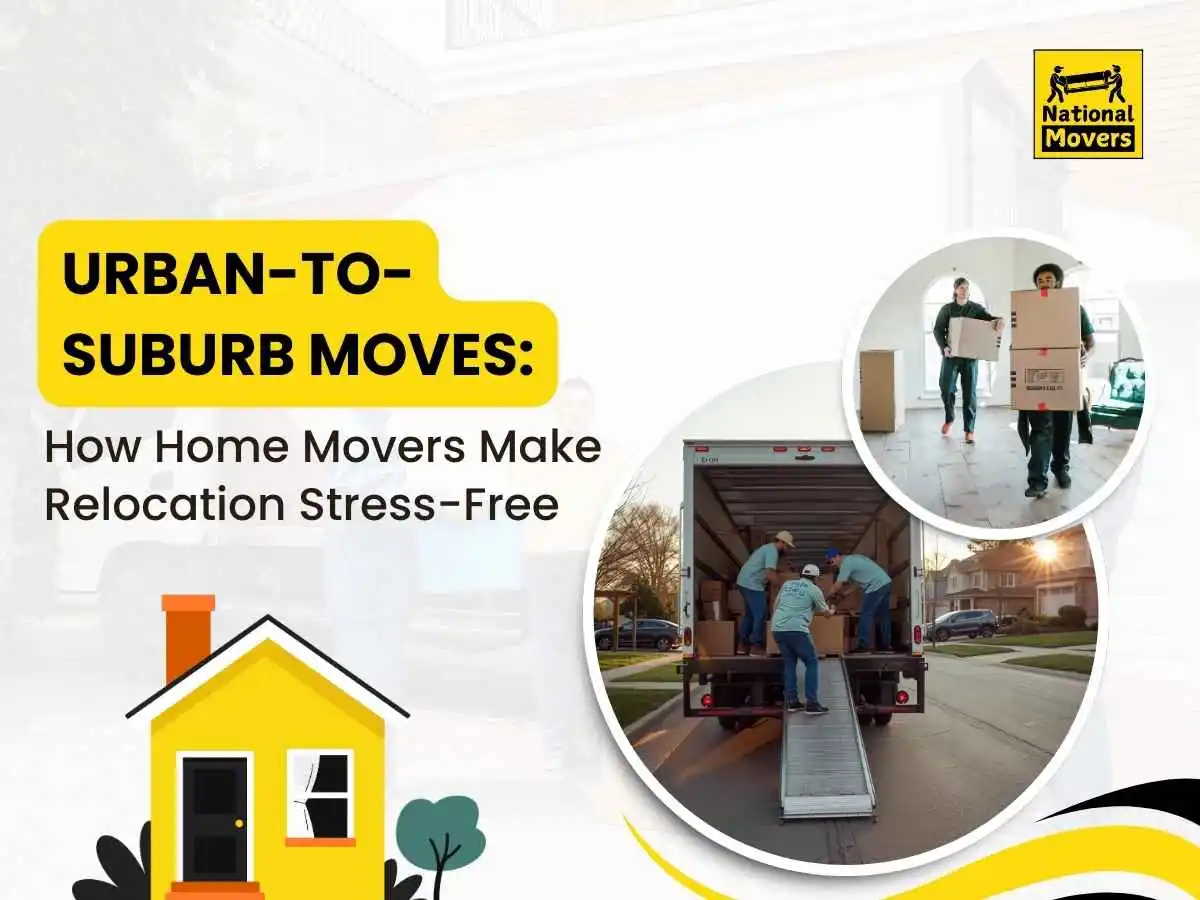
Urban-to-suburban relocation is no longer a lifestyle upgrade alone—it is a logistical transformation. Families and businesses leaving dense city environments for spacious suburban properties encounter an entirely different relocation reality. Longer distances, higher volume loads, access disparities, infrastructure limitations, and timeline sensitivity all converge into a move that cannot be handled with casual planning. This is precisely where professional Home Movers Services play a decisive role in turning a high-risk transition into a controlled, predictable operation.
Unlike short-distance urban relocations, suburban moves introduce a new risk profile. Larger floor space increases cubic cargo volume. Garages, sheds, outdoor storage units, and multi-level homes create load complexity. At the same time, the urban origin point still carries strict access controls such as elevator scheduling, parking permits, restricted loading windows, and building approvals. The move is therefore engineered across two opposing environments with entirely different operational constraints.
Professional home movers do not treat this as a transport job. They treat it as a logistics project.
The Hidden Operational Gap Between Urban and Suburban Moves
Urban moves are dominated by access restrictions and vertical transport. Suburban moves are dominated by distance, ground access, and load scale. Problems arise when movers apply urban techniques to suburban destinations without recalibrating vehicle size, suspension systems, labor allocation, and transit safeguards.
Urban buildings require route planning down to elevator capacity and loading dock access. Suburban homes require full driveway clearance analysis, slope assessment, truck turning radius validation, and ground stability checks. Weather exposure becomes a measurable risk factor in suburbs, particularly for timber furniture, electronics, and boxed inventory.
When these variables are not engineered in advance, the client experiences delays, property damage, unplanned labor extensions, and billing disputes. Stress is not caused by moving—it is caused by uncontrolled logistics.
Pre-Move Engineering: The True Foundation of a Stress-Free Relocation
Professional movers eliminate stress by neutralizing risk before the truck is ever loaded. The pre-move stage is where most failures are prevented.
A technical site inspection identifies access constraints at both ends of the move. Entry points, staircases, elevators, driveway gradients, and street clearance are measured and factored into crew size and vehicle selection. A structured load profile is then created to classify items by fragility, weight distribution, vibration sensitivity, and environmental exposure.
Based on this profile, movers determine packing systems, crating requirements, and truck suspension configuration. Finally, the move-day sequence is engineered to align building access windows, traffic load, and destination unloading staging. When this process is followed correctly, relocation timelines become stable and predictable rather than optimistic estimates.
This engineering-first approach is what separates professional operators from basic transport providers.
Packing as a Critical Damage-Control System
Damage prevention during urban-to-suburb moves is driven almost entirely by packing quality. Household materials and retail cartons are inadequate for long-haul suburban transport, particularly when vehicles traverse uneven terrain or weather-exposed routes.
Professional movers apply industrial-grade packing systems designed for load vibration and compression resistance. Furniture is wrapped under tension to prevent torque stress. Appliances are stabilized vertically to avoid compressor displacement. Electronics are climate-buffered, and fragile items are crated, not boxed. Proper palletization inside the vehicle ensures that weight transfer during braking and cornering does not collapse underlying loads.
Statistically, the majority of insurance claims in residential relocation originate from poor internal packing rather than traffic incidents. This is why professional packing is not a convenience—it is a structural safeguard.
Why Suburban Transit Requires Specialized Route Engineering
Distance changes everything. Urban relocations are constrained by access time. Suburban relocations are governed by route stability, fuel optimization, and time-accuracy over extended distances.
Professional movers use traffic modeling, low-bridge clearance databases, and vehicle-weight routing to eliminate detours, idling, and fuel volatility. Real-time fleet monitoring ensures that transit remains within compliance routing to preserve insurance validity. Without these controls, suburban moves frequently exceed quoted costs due to emergency rerouting, excessive fuel burn, and unscheduled labor extensions.
This is one of the primary reasons experienced clients select Affordable House Movers based on operational reliability rather than headline price.
Controlled Unloading: Where Most Relocation Damage Actually Occurs
Contrary to popular belief, most move-related damage happens at the destination during unloading and placement—not during transport. Suburban homes often involve tighter interior turns than city apartments, particularly in newer build layouts with narrow hallways and split-level access.
Professional movers apply reverse-load sequencing. Structural furniture is placed first, followed by room-sequenced cartons. Loads are oriented according to final placement to eliminate secondary carrying. Appliances are leveled immediately upon installation to prevent compressor and motor stress. Floor load limits are respected at every placement point to avoid long-term structural damage.
Without this structured unloading process, furniture repositioning multiplies handling risk and fatigue-related errors.
The Real Meaning of “Affordable” in Residential Relocation
The term Affordable House Movers is frequently misinterpreted as lowest price. In professional relocation economics, affordability is defined by cost certainty, not initial quotation.
True affordability is achieved through accurate labor forecasting, proper vehicle sizing, full-value transit protection, and the elimination of re-handling costs caused by poor sequencing. Low-cost operators reduce pricing by shrinking crews, skipping transit protection layers, and under-insuring cargo. This transfers financial risk directly to the client and often results in higher total expenditure after damage recovery, delays, and rework.
Professionally engineered moves cost less over the full relocation cycle—even if the initial quote appears higher.
Commercial Urban-to-Suburb Moves: A Higher Order of Complexity
Business relocations introduce asset chain-of-custody, data protection, downtime exposure, and inventory continuity risks. Suburban commercial moves often involve warehouse transfers, manufacturing equipment relocation, or decentralized office migration.
Professional movers execute these transitions in phased deployments. Infrastructure moves in controlled stages while operational continuity is preserved. Server systems, sensitive equipment, and high-value inventory remain under documented custody throughout transit. For businesses, stress-free relocation is not about comfort—it is about revenue protection.
How National Movers Deliver Controlled Urban-to-Suburban Transitions
National Movers, based in Tauranga and operating nationwide, applies a logistics-engineered relocation model for both residential and commercial clients. Their operations are structured around pre-move engineering inspections, licensed vehicle fleets equipped for long-distance load stability, dedicated residential and commercial crews, and full-value protection systems.
Nationwide servicing allows route consolidation, improved fuel efficiency, and scalable labor deployment across regions. This structural advantage results in predictable pricing and consistent service delivery regardless of destination distance.
Final Perspective
Urban-to-suburban relocation is not a transport task—it is a multi-stage logistics operation involving access management, load engineering, transit optimization, insurance compliance, and precision unloading. When these systems are properly controlled, relocation becomes a predictable, damage-free process. When they are improvised, the result is financial loss, property damage, and operational disruption.
Professional Home Movers Services remove stress not through reassurance, but through procedural certainty. They replace uncertainty with structure, risk with control, and disruption with continuity.
That is what stress-free relocation truly means